© Export Finance Australia
The views expressed in World Risk Developments represent those of Export Finance Australia at the time of publication and are subject to change. They do not represent the views of the Australian Government. The information in this report is published for general information only and does not comprise advice or a recommendation of any kind. While Export Finance Australia endeavours to ensure this information is accurate and current at the time of publication, Export Finance Australia makes no representation or warranty as to its reliability, accuracy or completeness. To the maximum extent permitted by law, Export Finance Australia will not be liable to you or any other person for any loss or damage suffered or incurred by any person arising from any act, or failure to act, on the basis of any information or opinions contained in this report.
China—Economic slowdown despite strong high-value exports
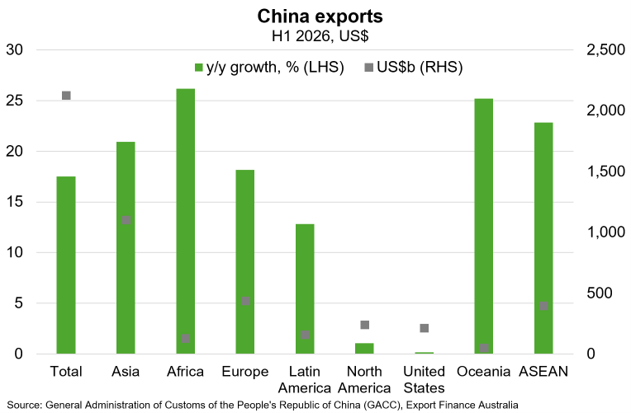
Growth in China’s economy is slowing and becoming more uneven. GDP growth eased to 4.3% y/y in Q2 2026, the weakest pace in three years and well below the 5.0% recorded in Q1. The drag is concentrated in the domestic economy—retail sales are growing only modestly, property investment is contracting sharply, and consumer confidence remains fragile. However, exports are providing a powerful offset, rising 17% y/y in H1 2026 (Chart) as global demand for AI-related equipment, green technology and advanced manufactured goods supports production. The result is a K-shaped economy. The upper leg reflects technology manufacturing, semiconductors, electric vehicles and other export-oriented sectors tied to global AI and renewable energy investment and China’s industrial upgrading strategy. The lower leg is the domestic economy, where construction, consumer goods and many traditional industries are constrained by weak demand, excess capacity and pressure on margins.
Beijing is likely to deploy targeted support, including for AI adoption and faster infrastructure spending, to keep full-year growth near its 4.5-5% target, rather than broad stimulus that would add to debt and structural imbalances. However, risks are on the downside. China is insulated from the direct effects of Middle East conflict, given large strategic reserves and diversified energy sources. But China’s investment-heavy growth model leading to surging exports is vulnerable to protectionism, weaker global demand and/or a setback in the AI investment cycle.
For Australian exporters, the implications are mixed. Slower construction activity and property investment will suppress demand for bulk commodities, including iron ore and metallurgical coal. Energy-intensive Chinese industries could also face pressure if global fuel and shipping costs remain elevated, while weak retail sales will challenge mass-consumption sectors. But the stronger side of China’s economy creates openings for exporters connected to advanced manufacturing, education, tourism, business services and premium agriculture.