© Export Finance Australia
The views expressed in World Risk Developments represent those of Export Finance Australia at the time of publication and are subject to change. They do not represent the views of the Australian Government. The information in this report is published for general information only and does not comprise advice or a recommendation of any kind. While Export Finance Australia endeavours to ensure this information is accurate and current at the time of publication, Export Finance Australia makes no representation or warranty as to its reliability, accuracy or completeness. To the maximum extent permitted by law, Export Finance Australia will not be liable to you or any other person for any loss or damage suffered or incurred by any person arising from any act, or failure to act, on the basis of any information or opinions contained in this report.
India—Economic growth prospects improve despite energy imports
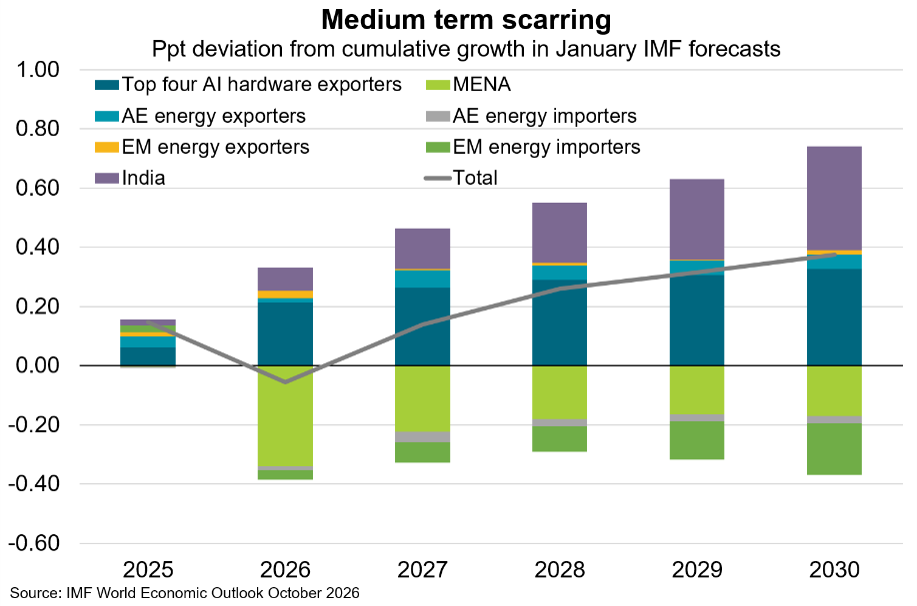
The global economic outlook has become increasingly uneven, with IMF growth downgrades concentrated among economies directly affected by the Middle East conflict and energy importing emerging markets. India is an exception (Chart). The IMF revised up India’s GDP growth forecast to 7.4% in 2026 and 7.0% in 2027, despite fuel comprising almost a third of goods imports. Higher energy costs will squeeze household budgets and company margins, but India is expected to remain among the world’s fastest growing major economies supported by broad-based strength in consumption, investment and services exports. Indeed, growth has averaged 7.5% since 2023 and outperformed expectations to reach 8.2% in H1 2026.
In the short term, further policy tightening to address rupee weakness and anchor inflation expectations is likely to weigh on growth momentum. Indeed, inflation rose to 5.5% in September, prompting the Reserve Bank of India to raise the policy rate to 5.5% in October, while the rupee depreciated to a record low. However, stronger medium term growth potential is increasingly evidenced by favourable demographics, rising public infrastructure investment, healthy corporate and financial sector balance sheets, and ongoing structural reforms. For instance, simplification of the tax system and labour codes and new trade agreements that could broaden market access. Risks to the outlook stem from prolonged energy disruption, further trade restrictions, tighter financial conditions and El Niño weather impacts. Meanwhile, AI adoption could weigh on services exports and employment. However, continued reform and strong foreign exchange reserves strengthen India’s resilience to external shocks.
Australia’s goods and services exports to India grew an annual average rate of 13% over the five years to 2025 to $35 billion, making India our fifth largest export market. Stronger growth potential, infrastructure development, private investment and reform momentum are likely to offer further opportunities.