© Export Finance Australia
The views expressed in World Risk Developments represent those of Export Finance Australia at the time of publication and are subject to change. They do not represent the views of the Australian Government. The information in this report is published for general information only and does not comprise advice or a recommendation of any kind. While Export Finance Australia endeavours to ensure this information is accurate and current at the time of publication, Export Finance Australia makes no representation or warranty as to its reliability, accuracy or completeness. To the maximum extent permitted by law, Export Finance Australia will not be liable to you or any other person for any loss or damage suffered or incurred by any person arising from any act, or failure to act, on the basis of any information or opinions contained in this report.
Australia—Business confidence falls amid operating headwinds
The energy price shock stemming from conflict in the Middle East is exacerbating existing inflation pressures. The Reserve Bank of Australia (RBA) now forecasts headline inflation to peak at 4.8% in mid-2026, assuming oil prices recede gradually over coming quarters, while core inflation is forecast to return to the 2-3% target band only in H2 2027. Inflation pressures saw the RBA hike the cash rate this month for the third time this year, by 25 basis points to 4.35%, the highest among major developed economies. Market expectations are for the cash rate to rise to 4.6% by end-2026.
Economic uncertainty remains elevated, and demand growth is expected to slow, limiting the ability of businesses to pass on cost increases. Indeed, the April NAB Business Survey found that pressure on margins is increasing, as purchase cost growth outpaces final product price growth. Reflecting these challenges, business confidence was strongly negative across all industries and regions in April, after recording the second largest monthly fall in the survey’s history in March. A stronger Australian dollar—up 7% against the US dollar this year to near its highest level since April 2022—presents an additional challenge for exporters by eroding international competitiveness, particularly for manufacturing goods and services exports, potentially reducing supply further.
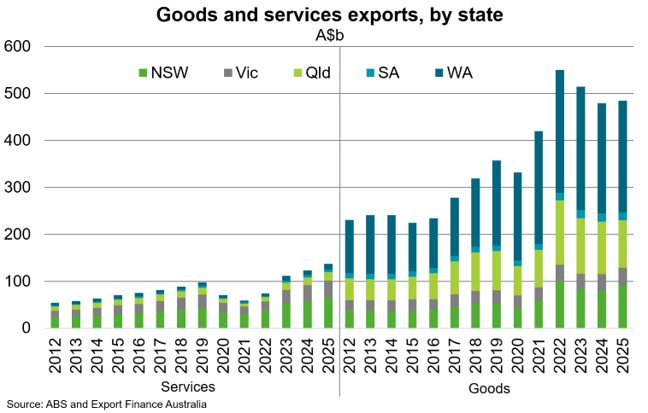
Higher operating costs, margin compression and the softening demand outlook are weighing on business confidence and investment nationwide. However, the larger mining states—Western Australia and Queensland—will continue to outperform as energy-related exports benefit from higher global prices. In particular, Western Australia accounted for 46% of Australia’s resources and energy exports last year and 68% of mineral exploration (other than for petroleum). South Australia’s defence exports provide additional support. Meanwhile, NSW and Victoria accounted for 72% of Australia’s services exports last year (Chart), with discretionary and price sensitive services likely to see outsized headwinds.