© Export Finance Australia
The views expressed in World Risk Developments represent those of Export Finance Australia at the time of publication and are subject to change. They do not represent the views of the Australian Government. The information in this report is published for general information only and does not comprise advice or a recommendation of any kind. While Export Finance Australia endeavours to ensure this information is accurate and current at the time of publication, Export Finance Australia makes no representation or warranty as to its reliability, accuracy or completeness. To the maximum extent permitted by law, Export Finance Australia will not be liable to you or any other person for any loss or damage suffered or incurred by any person arising from any act, or failure to act, on the basis of any information or opinions contained in this report.
Australia—Record global military expenditure bolsters export potential
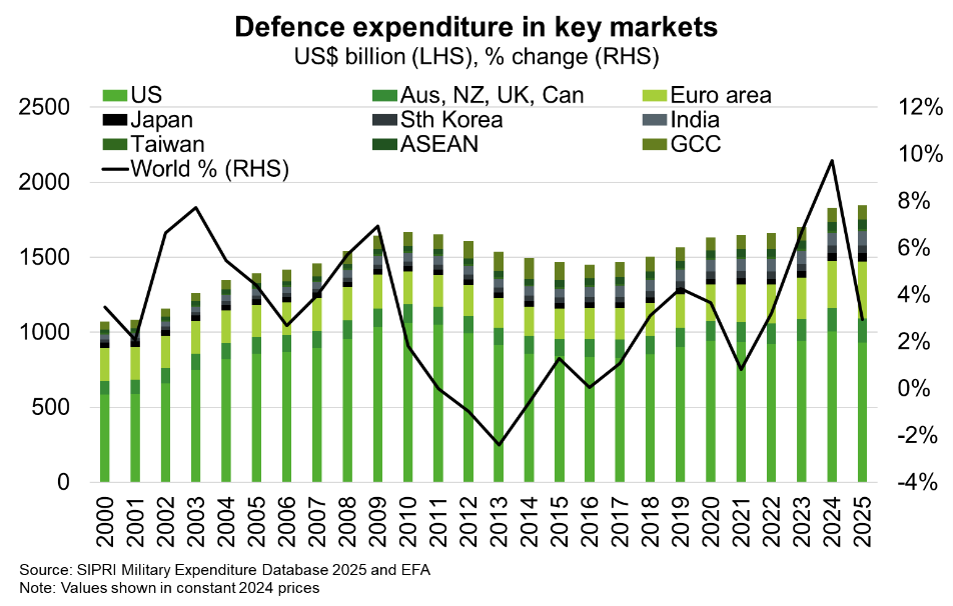
Global military expenditure hit a record US$2.9 trillion or 2.5% of GDP in 2025. The US remained the world’s largest military spender at US$954 billion. Europe and Southeast Asia saw the highest regional increases at 14% and 15% respectively. Middle East countries maintained some of the highest expenditure as a share of GDP, including Israel (8% of GDP), Saudi Arabia (6%), Oman (6%), Kuwait (5%) and Jordan (5%).
Increased NATO commitments and conflict in the Middle East will push expenditure even higher in coming years. The capabilities of Australian defence exporters align with some of the spending priorities of Australia’s large strategic partners, suggesting new export opportunities. For example, the US budget request of US$1.5 trillion in FY2027, if approved by congress, includes funds for weapons systems, drone capabilities and shipbuilding. Japan will become the third-largest defence spender with a JPY9 trillion (US$58 billion) FY2026 defence budget, prioritising longer-range missiles, air and missile defence capabilities, unmanned assets, and space and cyberspace capabilities. Canada’s pledge to increase investment in core military capabilities to 3.5% of GDP will include spending on submarines, aircraft, drones, sensors and radar systems. Germany plans to spend €83 billion on defence in 2026, up €20 billion compared to 2025, with new funds used for combat drones, helicopters, fighter jets, maritime patrol aircraft, infantry vehicles and protective clothing for soldiers.